
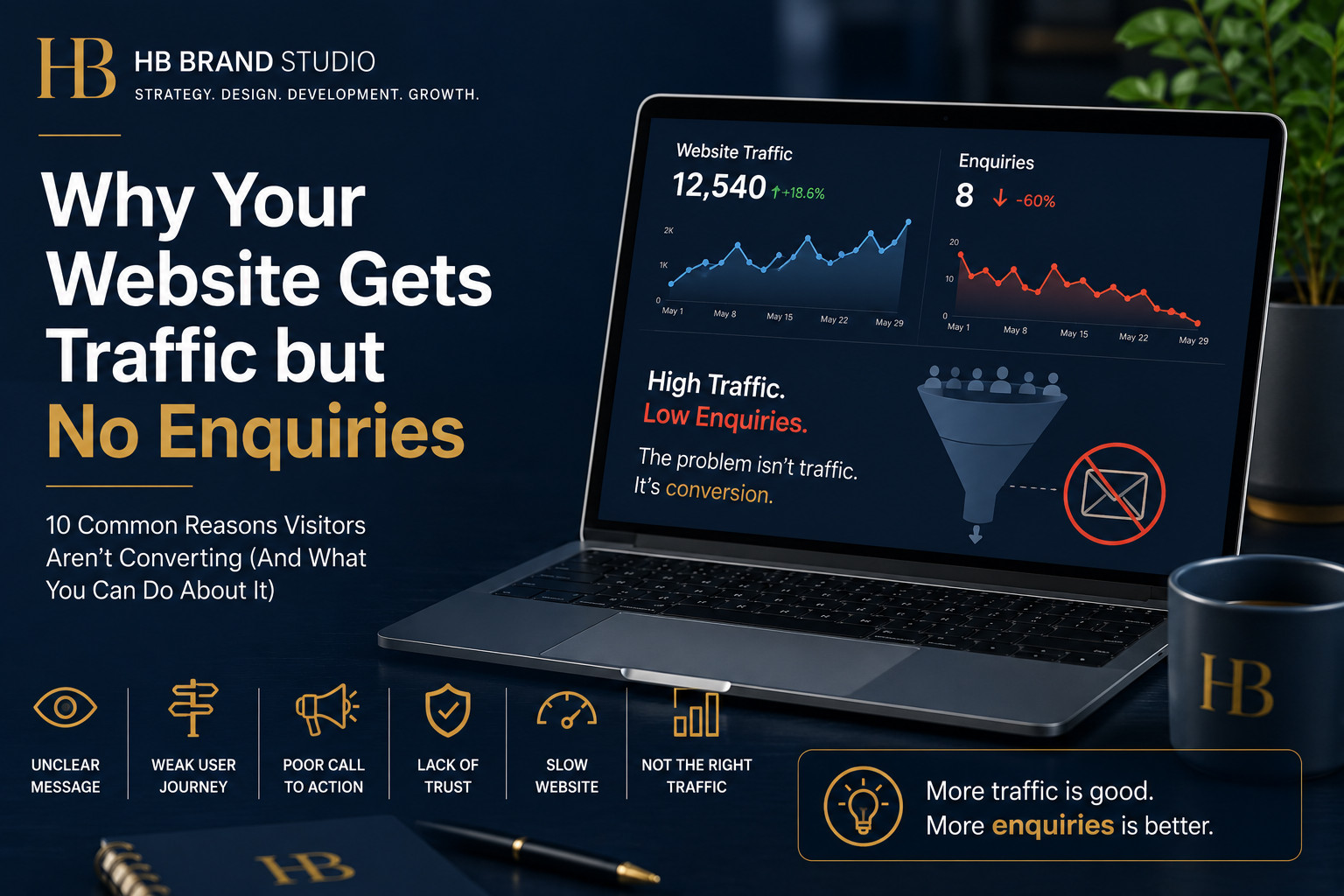
Why Your Website Gets Traffic but No Enquiries
Getting people to visit your website is only half the job.
If visitors arrive but nobody contacts you, requests a quote, books a consultation or buys from you, the problem may not be your traffic.
It may be your website.
A website can attract hundreds or even thousands of visitors and still generate very few enquiries if the visitor experience isn’t designed around conversion.
Here are 10 common reasons why your website gets traffic but no enquiries.
1. Visitors Don’t Understand What You Do
People shouldn’t have to work out what your business offers.
When someone lands on your homepage, they should quickly understand:
- What your business does
- Who you help
- What problem you solve
- Why they should consider you
- What they should do next
If your headline is vague or overly focused on your company rather than your customer’s needs, visitors may leave before exploring further.
For example:
“Welcome to ABC Solutions”
doesn’t tell the visitor much.
Compare that with:
“Commercial Cleaning Services for Businesses Across Manchester”
The second message immediately provides context.
Clarity reduces friction.
2. Your Website Looks Good but Doesn’t Guide Visitors
A visually attractive website isn’t automatically a high-converting website.
Design should help visitors understand what matters and where to go next.
If every section has the same visual weight, users may not know where to focus.
Strong visual hierarchy helps guide visitors from:
Problem → Solution → Evidence → Action
This is one of the reasons a good business website needs more than attractive visuals.
It needs a clear user journey.
You can read more about the fundamentals in our guide to what makes a good business website.
3. Your Call to Action Is Weak
One of the simplest problems is also one of the most common.
Visitors may be interested in your service but have no clear idea what to do next.
Your website might say:
Learn More
when the visitor is actually ready to:
Request a Quote
or:
Book a Consultation
Your calls to action should match the visitor’s intent.
For service businesses, useful CTAs might include:
- Get a Quote
- Book a Consultation
- Request a Callback
- Start a Project
- Speak to an Expert
- Contact Us
The goal isn’t to add more buttons.
It’s to make the appropriate next step obvious.
4. There Isn’t Enough Trust
Visitors may understand what you offer but still hesitate to contact you.
Why?
Because they don’t know whether they can trust you.
Before taking action, potential customers may want evidence that your business is legitimate and capable.
Useful trust signals include:
- Customer reviews
- Testimonials
- Case studies
- Project examples
- Certifications
- Awards
- Client logos
- Guarantees
- Clear business information
- Professional contact details
Don’t simply tell people that you’re trustworthy.
Give them evidence.
5. Your Website Doesn’t Address Customer Concerns
Potential customers usually have questions before making a decision.
For example:
How much does it cost?
How long does it take?
Do you work in my area?
Have you worked with businesses like mine?
What happens after I enquire?
What’s included?
If your website doesn’t answer these questions, visitors may leave and continue looking elsewhere.
Good conversion-focused content anticipates objections before they become reasons not to buy.
6. Your Contact Process Is Too Difficult
Imagine a visitor has finally decided to contact you.
Then they find a form asking for:
- Full name
- Company name
- Address
- Phone number
- Industry
- Budget
- Project details
- How they heard about you
- Several other unnecessary questions
That’s a lot of friction.
Only ask for the information you genuinely need at that stage.
For many businesses, a simple enquiry form can be enough to start the conversation.
You can collect additional information later.
7. Your Website Is Too Slow
A visitor can’t convert if they leave before the page finishes loading.
Slow performance can create frustration and reduce the quality of the overall user experience.
Common causes include:
- Large images
- Poor hosting
- Too many plugins
- Unnecessary scripts
- Unoptimised code
- Excessive animations
- Poor caching
- Third-party tools
Performance should therefore be considered part of conversion optimisation, not just technical SEO.
A fast website makes it easier for visitors to reach the information and actions that matter.
8. Your Traffic Isn’t the Right Traffic
Sometimes the website isn’t the problem.
The traffic is.
Imagine you sell premium commercial photography services but most of your visitors are searching for:
“free photography tutorials”
You’re receiving traffic, but those visitors aren’t necessarily potential customers.
This is why traffic volume alone isn’t a useful measure of marketing success.
You need to attract people who have a genuine connection to your offer.
Good SEO focuses on search intent, not simply increasing visitor numbers.
9. Your Service Pages Are Too Weak
Many businesses put most of their effort into the homepage.
Then the actual service pages contain only a few paragraphs.
That’s a missed opportunity.
A strong service page should help the visitor understand:
- What the service is
- Who it’s for
- What problem it solves
- What’s included
- Why your approach is different
- What results or outcomes are possible
- Why they should trust you
- What they should do next
For many businesses, service pages are where commercial search traffic should ultimately convert.
10. You’re Not Measuring What Happens
You can’t improve what you don’t measure.
If your website gets traffic but you’re not tracking enquiries, calls, forms or other important actions, you may not know where the problem exists.
Useful measurements can include:
- Organic traffic
- Landing page performance
- Contact form submissions
- Phone clicks
- CTA clicks
- Booking completions
- Ecommerce transactions
- Conversion rate
- Traffic source
The objective isn’t to track every possible metric.
It’s to understand whether visitors are taking the actions that matter to the business.
Traffic Isn’t the Goal
It’s easy to become obsessed with visitor numbers.
More traffic sounds good.
But imagine two websites:
Website A
10,000 visitors
20 enquiries
Website B
2,000 visitors
100 enquiries
Which website would you rather own?
Website B.
The goal isn’t simply to get more people onto your website.
The goal is to get more of the right people to take the right action.
What Should You Do If Your Website Gets Traffic but No Enquiries?
Start with the fundamentals.
Step 1: Check your traffic
Find out where visitors are coming from and what they’re searching for.
Step 2: Review your messaging
Can someone understand your offer within a few seconds?
Step 3: Review your user journey
Can visitors easily find the information they need?
Step 4: Improve trust
Add relevant evidence, reviews, case studies and credibility signals.
Step 5: Review your CTAs
Make the next action clear and relevant.
Step 6: Reduce friction
Make forms, navigation and contact options easier to use.
Step 7: Improve performance
Check mobile experience, page speed and technical issues.
Step 8: Measure conversions
Track the actions that actually matter to the business.
Your Website Should Do More Than Generate Traffic
Traffic is useful when it leads somewhere.
A visitor should be able to move naturally from:
Discovery → Understanding → Trust → Action
If your website stops that journey at any stage, you’re potentially losing opportunities.
This is why website design, SEO and conversion optimisation shouldn’t be treated as completely separate activities.
They work best when they work together.
Final Thoughts
If your website gets traffic but generates very few enquiries, don’t immediately assume you need more traffic.
First, find out why the visitors you already have aren’t converting.
The solution could be better messaging, stronger service pages, clearer calls to action, more trust signals, faster performance or a simpler user journey.
Sometimes the biggest opportunity isn’t getting more people to your website.
It’s getting more value from the people who are already there.
At HB Brand Studio, I look beyond traffic numbers to consider how strategy, UX, design, SEO and conversion work together to turn website visitors into genuine business opportunities.