
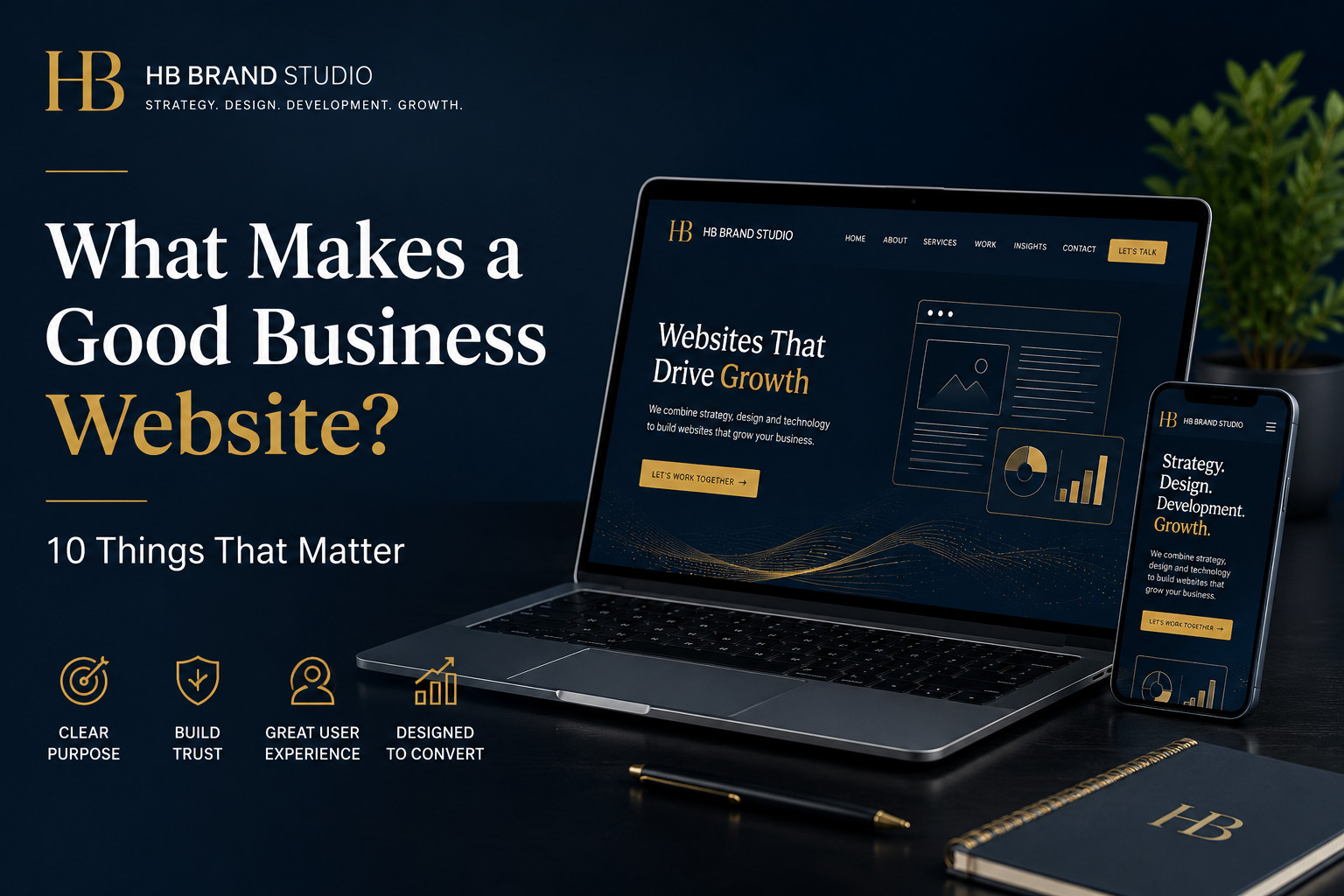
A good business website does more than look professional.
It should help people understand what you do, trust your business and take the next step.
That might mean submitting an enquiry, booking an appointment, requesting a quote, making a purchase or calling your business.
The problem is that many websites are designed around appearance first and business objectives second. They may have attractive colours, animations and polished imagery, but still fail to generate meaningful results.
A strong business website brings together strategy, design, usability, performance, SEO and conversion.
Here are 10 things that matter.
1. A Clear Purpose
Before choosing colours, fonts or layouts, you need to know what the website is supposed to achieve.
Is the primary goal to:
- Generate enquiries?
- Get phone calls?
- Sell products?
- Book appointments?
- Build credibility?
- Generate quote requests?
- Educate potential customers?
A website can have several goals, but it should have one clear primary objective.
Every major element on the site should support that objective.
If a visitor cannot quickly understand what the website is for, the design is already working against you.
2. A Clear Value Proposition
Your website should answer one important question quickly:
Why should someone choose your business?
Your homepage shouldn’t force visitors to read several paragraphs before understanding what you offer.
A strong value proposition communicates:
- What you do
- Who you help
- The problem you solve
- Why your business is worth considering
For example, instead of simply saying:
“Professional Web Design Services”
a stronger message could communicate the business outcome:
“Websites designed to turn more visitors into enquiries.”
The second statement gives the visitor a reason to continue.
3. Simple, Intuitive Navigation
Visitors shouldn’t have to figure out how your website works.
Your navigation should make the important information easy to find.
For most business websites, this usually means giving users clear access to pages such as:
- Home
- About
- Services
- Work or Case Studies
- Insights
- Contact
The exact structure depends on the business, but the principle remains the same:
Make important information easy to find.
Complex navigation can create unnecessary friction and make users leave before they reach the information they need.
4. Strong Visual Hierarchy
Good design isn’t simply about making a website look attractive.
It’s about controlling attention.
A visitor should naturally notice the most important information first, followed by supporting information and then the next action.
Visual hierarchy can be created through:
- Typography
- Font size
- Spacing
- Contrast
- Position
- Colour
- Images
- Buttons
- Section structure
Your most important message shouldn’t compete with five other elements for attention.
A well-designed page guides the visitor through the information in a logical order.
5. Mobile Responsiveness
A website that looks excellent on a desktop can still provide a poor experience on mobile.
Mobile users need:
- Readable text
- Comfortable spacing
- Easy-to-use buttons
- Simple navigation
- Fast-loading pages
- Properly scaled images
- Forms that are easy to complete
Responsive design isn’t an optional extra.
Your website needs to work properly across the devices your customers actually use.
This is particularly important for service businesses where visitors may discover the business through search or social media while using their phones.
6. Fast Performance
A beautiful website that takes too long to load can still lose customers.
Performance affects usability, engagement and the overall experience visitors have with your business.
Common causes of slow websites include:
- Oversized images
- Poor hosting
- Unnecessary plugins
- Excessive JavaScript
- Unoptimised CSS
- Third-party scripts
- Poorly configured caching
- Bloated page builders or themes
Website speed should therefore be considered during development, not treated as something to fix after the website is finished.
7. Trust Signals
People don’t automatically trust a business because it has a website.
Your website needs to give visitors reasons to believe that you’re legitimate, capable and worth contacting.
Useful trust signals can include:
- Testimonials
- Reviews
- Case studies
- Client logos
- Certifications
- Awards
- Professional photography
- Clear contact information
- Business details
- Guarantees where appropriate
- Evidence of previous results
The strongest trust signals are specific and believable.
Instead of simply saying:
“We’re the best in the industry.”
show visitors evidence that supports your claim.
8. Clear Calls to Action
Every important page should give the visitor a logical next step.
That could be:
Get a Quote
Book a Consultation
Request a Callback
Contact Us
Buy Now
View Our Services
The CTA should match the visitor’s intent.
Someone reading an introductory article may not be ready to make a purchase immediately. A softer next step may be more appropriate.
On a service page, however, a clear enquiry CTA can be much more relevant.
The goal isn’t to put buttons everywhere.
The goal is to make the next step obvious.
9. Search Engine Optimisation
A good website also needs to be discoverable.
SEO should be considered from the beginning of the website project rather than added as an afterthought.
Important areas include:
- Search intent
- Keyword targeting
- Page titles
- Meta descriptions
- Heading structure
- Internal linking
- Image optimisation
- URL structure
- Canonical URLs
- XML sitemaps
- Structured data
- Indexation
- Technical performance
- Helpful content
But SEO isn’t simply about inserting keywords into pages.
Your content needs to answer the questions your potential customers are actually asking.
A technically optimised website with weak content may still struggle to attract qualified search traffic.
10. A Clear User Journey
Perhaps the most important element is how everything works together.
A good website doesn’t treat every page as an isolated design.
It creates a journey.
For example:
Google search → service page → proof/results → explanation → CTA → enquiry
Or:
Social media → blog article → related service → case study → contact
Every stage should move the visitor closer to making an informed decision.
This is where website strategy becomes particularly important.
Design, SEO, content and conversion shouldn’t operate independently.
They should work together.
What Makes a Website “Good”?
A good business website isn’t necessarily the website with the most animations, the most expensive photography or the most complicated design.
It’s the website that successfully helps the right people:
- Understand the business
- Find the information they need
- Trust the company
- Take the appropriate next step
That requires more than visual design.
It requires strategy.
A Website Should Support the Business
Your website is one part of your wider digital presence.
It should support your marketing, sales and customer journey rather than simply exist as an online brochure.
Before building or redesigning a website, ask:
- What do I want the website to achieve?
- Who am I trying to reach?
- What questions do potential customers have?
- Why should they choose my business?
- What action should visitors take?
- What evidence can I provide to build trust?
- How will people find the website?
The answers should influence the structure, content and design.
Final Thoughts
A professional business website should look good, but appearance is only one part of the equation.
The strongest websites combine strategy, UX, design, performance, SEO and conversion to create an experience that works for both the visitor and the business.
If your current website looks good but isn’t generating the enquiries, sales or opportunities you expect, the problem may not be the design alone.
It may be the strategy behind it.
At HB Brand Studio, I focus on building websites around business goals, user experience and measurable growth rather than simply creating attractive pages.