
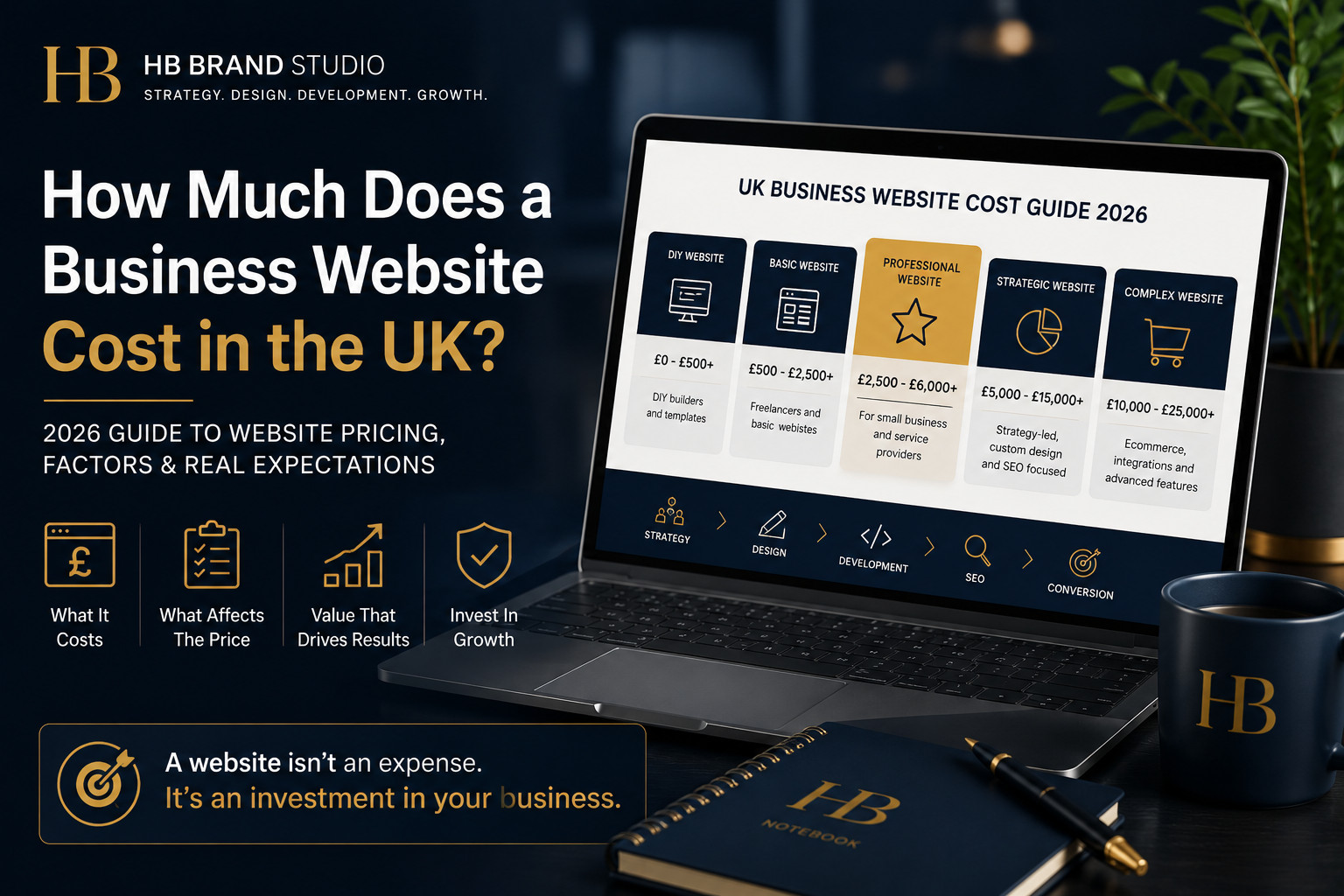
How Much Does a Business Website Cost in the UK? 2026 Guide
One of the first questions many business owners ask before starting a website project is:
“How much does a website cost?”
The honest answer is that there isn’t one fixed price.
In the UK, a simple business website can cost hundreds of pounds, while a professionally designed website can cost several thousand. More complex websites involving ecommerce, custom functionality, integrations or extensive strategy can cost significantly more. Current 2026 UK pricing guides show this wide range clearly.
The important question isn’t simply how much does a website cost?
It’s:
What are you getting for that investment?
How Much Does a Business Website Cost in the UK?
As a broad 2026 guide, you can expect something like:
| Website type | Typical UK investment |
|---|---|
| DIY website | £0–£500+ |
| Basic freelancer website | £500–£2,500+ |
| Professional small business website | £2,500–£6,000+ |
| Strategic agency/studio website | £5,000–£15,000+ |
| Complex website / ecommerce / custom development | £10,000–£25,000+ |
| Large bespoke digital platforms | £25,000+ |
These are guideline ranges rather than fixed market prices. The actual cost depends on the scope, expertise involved, content, functionality, strategy and level of customisation.
For example, recent UK guides place regional professional builds around £2,500–£6,000+, while other agencies report £5,000–£15,000 for broader SME marketing websites.
So if you’ve received two quotes of £1,000 and £6,000, that doesn’t automatically mean one company is overcharging.
You may simply be comparing two completely different projects.
What Determines the Cost of a Website?
Website pricing isn’t normally determined by the number of pages alone.
Several factors influence the final investment.
Read: Website Redesign: 10 Signs Your Business Website Needs One
1. Website Strategy
Strategy is often overlooked because it isn’t something visitors can immediately see.
Before the design begins, someone needs to determine:
- Who the website is targeting
- What the business wants to achieve
- What services should receive priority
- How visitors should move through the website
- What objections need to be addressed
- What actions visitors should take
- How the website fits into the wider marketing strategy
A website built without strategy may technically work, but it can still fail to generate results.
Strategic planning adds value because you’re solving the right problem before spending money on design and development.
2. Design
There’s a major difference between placing content into a template and developing a considered visual experience.
Design costs can vary depending on:
- Custom layouts
- Brand development
- UX research
- Wireframing
- Typography
- Responsive design
- Interaction design
- Photography and imagery
- Animation
- Design revisions
A five-page website can therefore cost more than a ten-page website if significantly more design work is required.
3. Content
Someone has to create the content.
That includes:
- Headlines
- Body copy
- Service descriptions
- About page content
- Case studies
- Calls to action
- Blog content
- Images
- Videos
Some website packages include content creation.
Others require the client to provide everything.
This is one reason two apparently similar quotes can have very different prices.
4. Development
Development turns the design into a functioning website.
The cost depends on the technology and functionality required.
A standard WordPress business website is very different from a website requiring:
- Custom calculators
- Booking systems
- Memberships
- Ecommerce
- Customer portals
- API integrations
- Advanced forms
- Custom databases
- Bespoke functionality
The more complex the requirements, the more development time and testing are required.
5. SEO
SEO can be included at different levels.
Basic website SEO might include:
- Page titles
- Meta descriptions
- Heading structure
- Image optimisation
- XML sitemap
- Indexation settings
- Internal linking
- Basic schema
- Search-friendly URLs
More comprehensive SEO involves ongoing keyword research, content creation, technical optimisation, authority building and performance monitoring.
These are very different services and shouldn’t be treated as the same thing.
6. Website Functionality
A brochure-style website is relatively straightforward.
A website selling hundreds of products is not.
The same applies to websites requiring:
- Online payments
- Product filtering
- Customer accounts
- Membership areas
- Appointment booking
- Advanced search
- Automated emails
- CRM integrations
Every additional system introduces development, testing and maintenance requirements.
What Should a Professional Business Website Include?
When comparing website quotes, don’t focus only on the price.
Look at what is actually included.
A professional business website may include:
Strategy
- Website planning
- Audience research
- User journey planning
- Conversion strategy
- Content structure
Design
- UX/UI design
- Responsive layouts
- Brand integration
- Mobile optimisation
- Design system
Development
- WordPress development
- CMS setup
- Forms
- Integrations
- Responsive development
- Browser testing
SEO
- Technical SEO foundations
- Metadata
- Heading structure
- Image optimisation
- Sitemap
- Indexation
- Internal linking
- Schema where appropriate
Performance
- Image optimisation
- Caching
- Asset optimisation
- Performance testing
- Core Web Vitals considerations
Launch
- Domain connection
- SSL
- Analytics
- Search Console
- Redirects
- Final testing
- Deployment
The exact scope varies by provider, so always ask for a written breakdown.
Why Are Some Websites So Cheap?
You may see website offers for a few hundred pounds.
That doesn’t automatically mean the website will be bad.
A low-cost website can make sense when:
- The business is very small
- The requirements are simple
- The client provides the content
- A template is being used
- There are few revisions
- No advanced functionality is required
- The business simply needs a basic online presence
The problem occurs when a business expects a £500 website to deliver the strategic planning, custom design, SEO, content and conversion optimisation of a £5,000+ project.
Those are different levels of service.
Cheap Isn’t Always Expensive
There’s a common saying that “cheap websites become expensive.”
Sometimes that’s true.
But the opposite can also be true.
Expensive doesn’t automatically mean better.
A £15,000 website can still be poorly planned.
A £2,500 website can perform extremely well if its scope is appropriate and the work is executed properly.
The objective should be to find the right investment for the business.
Freelancer vs Studio vs Agency
Who builds the website also affects pricing.
Freelancer
Freelancers can offer lower costs because they generally have lower overheads.
This can be a good option for straightforward projects.
However, the scope of expertise varies significantly between individuals.
Small Studio
A specialist studio can provide a more strategic and design-focused service while maintaining a relatively lean structure.
This can be particularly suitable for businesses that want a professional website without the overhead associated with a large agency.
Agency
Larger agencies typically have larger teams and can handle complex projects involving multiple disciplines.
That can be valuable for larger organisations or projects with significant technical requirements.
But you shouldn’t pay for a large agency structure if your project doesn’t require it.
Don’t Compare Quotes by Page Count
This is one of the biggest mistakes businesses make.
Imagine you receive these two quotes:
Website A
5 pages — £1,500
Website B
5 pages — £5,000
At first glance, Website A appears to be the better deal.
But what happens if Website B includes:
- Strategy
- UX planning
- Custom design
- Professional copywriting
- SEO setup
- Conversion planning
- Performance optimisation
- Analytics
- Testing
- Training
- Post-launch support
And Website A includes:
- Template setup
- Client-provided content
- Basic styling
- Contact form
- Launch
They’re not the same product.
Compare scope, not page count.
What About Ongoing Website Costs?
The initial build isn’t necessarily your only website expense.
You may also need to budget for:
Domain
Your domain name normally has an ongoing registration cost.
Hosting
Your hosting provider charges for the infrastructure where your website lives.
Maintenance
Maintenance can include:
- WordPress updates
- Plugin updates
- Security monitoring
- Backups
- Bug fixes
- Technical support
SEO
If you want to grow organic visibility, SEO is generally an ongoing activity rather than a one-time checkbox.
Content
Publishing useful content can support your long-term organic growth.
Premium tools
Depending on the website, you may have recurring costs for plugins, integrations, booking systems, ecommerce tools or other software.
Always ask whether these costs are included in the initial quote.
How to Choose the Right Website Budget
Instead of asking:
“What’s the cheapest website I can get?”
ask:
“What does my business actually need the website to accomplish?”
Read: What Makes a Good Business Website? 10 Things That Matter
A new local business may only need a focused website that establishes credibility and generates calls.
A growing service business may need a stronger lead-generation system.
An established company may need SEO, content, conversion optimisation and integrations.
An ecommerce business has completely different requirements.
The right budget depends on the role your website needs to play.
Questions to Ask Before Accepting a Website Quote
Before choosing a web designer or agency, ask:
- What’s included in the price?
- Who provides the content?
- Is the design custom or template-based?
- Is SEO included?
- Is mobile optimisation included?
- Who owns the website after completion?
- Who owns the domain?
- Who owns the hosting account?
- What happens if I want to leave?
- Are there ongoing fees?
- How many revisions are included?
- What happens after launch?
- Is maintenance included?
- Are analytics and Search Console configured?
- What happens if something breaks?
These questions can reveal more than the headline price.
So, How Much Should You Spend?
There isn’t a universal number.
For a straightforward small business website, a few thousand pounds can be a reasonable starting point for professional work.
For a more strategic website designed to support marketing, SEO and lead generation, the investment can move into the £5,000–£15,000+ range.
For ecommerce, complex integrations or bespoke platforms, the budget can increase significantly. Current UK pricing guides show this broad spread across different project types.
The important thing is to make sure the website’s scope matches the investment.
Final Thoughts
A website shouldn’t be treated as a commodity where the lowest quote automatically wins.
Your website represents your business, communicates your value and can become one of your most important sources of enquiries and sales.
The right question isn’t:
“How much does a website cost?”
It’s:
“What does my business need its website to achieve, and what investment is required to achieve it properly?”
At HB Brand Studio, I approach website projects around strategy, design, development, SEO and conversion, with the goal of creating a website that supports business growth rather than simply putting a business online.