
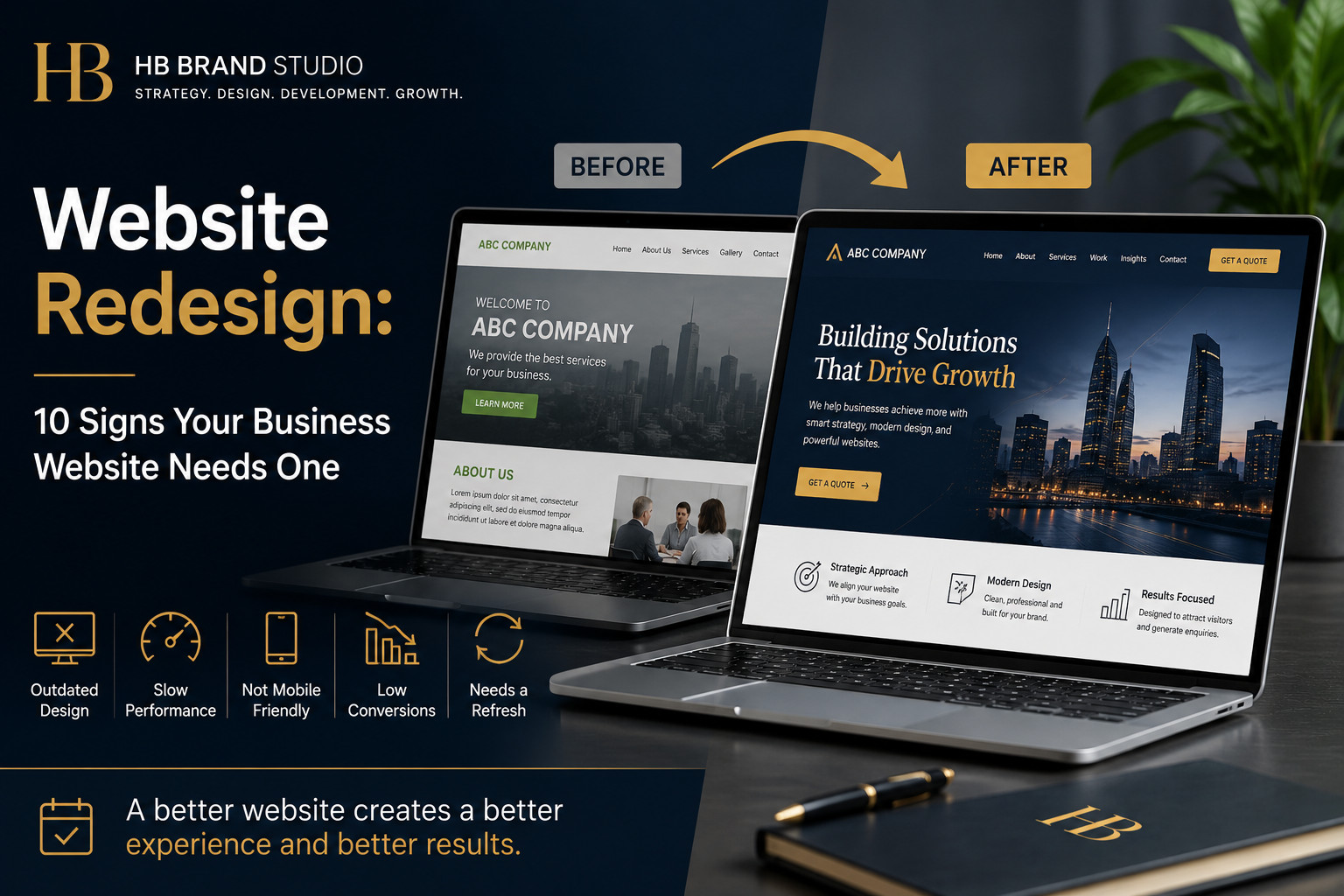
Website Redesign: 10 Signs Your Business Website Needs One
Your website might still be online, but that doesn’t necessarily mean it’s still working for your business.
A website can become outdated without the business owner noticing it immediately. Your services change. Your branding evolves. Customer expectations change. Search engines change. Technology improves.
Eventually, the website that once worked well can become a barrier to growth.
A website redesign isn’t simply about making an old website look newer. A successful redesign should improve the strategy, user experience, performance, search visibility and conversion journey.
Here are 10 signs that your business website may be ready for a redesign.
1. Your Website Looks Outdated
First impressions matter.
Visitors will often form an opinion about a business based on its website before they ever speak to someone from the company.
An outdated website may have:
- Old visual styles
- Poor typography
- Inconsistent spacing
- Low-quality imagery
- Cluttered layouts
- Outdated navigation
- Design elements that no longer reflect your brand
The problem isn’t necessarily that the website looks old.
The bigger problem is what the design communicates about the business.
If your website looks neglected, visitors may question whether the business itself is equally outdated.
A modern redesign should reflect where your business is now, not where it was several years ago.
2. Your Website Isn’t Generating Enough Enquiries
This is one of the biggest reasons to consider a redesign.
If people are visiting your website but very few are contacting you, booking a call or requesting a quote, something in the journey may be preventing them from taking action.
Possible problems include:
- Weak calls to action
- Unclear messaging
- Poor service pages
- Lack of trust signals
- Confusing navigation
- Difficult contact forms
- Too much information without clear direction
A redesign gives you the opportunity to examine the entire conversion journey rather than simply changing the colours and layout.
Your website should make it easy for the right visitor to understand what you do, why it matters and what to do next.
3. Your Website Doesn’t Work Well on Mobile
A website that looks good on a desktop but performs poorly on mobile is creating a poor experience for a significant portion of its visitors.
Common mobile problems include:
- Text that is difficult to read
- Buttons that are too small
- Horizontal scrolling
- Menus that are difficult to use
- Images overflowing the screen
- Slow loading
- Forms that are frustrating to complete
Responsive design should be considered throughout the website, not added as an afterthought.
If your current website wasn’t built with modern responsive practices in mind, a redesign may be the most practical solution.
4. Your Messaging No Longer Reflects Your Business
Businesses evolve.
You may have:
- Added new services
- Changed your target market
- Expanded into new locations
- Changed your pricing
- Developed a stronger value proposition
- Changed your positioning
- Started serving larger clients
But your website may still be communicating the same message it did years ago.
This creates a disconnect.
Someone visiting your website should immediately understand what your business does and whether you’re relevant to them.
A redesign is an opportunity to revisit the messaging before rebuilding the visual design.
5. Your Website Is Slow
Speed is both a user experience and technical SEO consideration.
A slow website can make visitors leave before they ever see your services or contact information.
Common causes include:
- Large unoptimised images
- Excessive plugins
- Poor hosting
- Unnecessary scripts
- Bloated page structures
- Poor caching
- Unoptimised fonts
- Third-party integrations
Sometimes performance issues can be fixed without rebuilding the entire website.
But if poor performance is deeply connected to the site’s theme, structure, plugins or development approach, a redesign may provide a better long-term solution.
6. Your Website Is Difficult to Update
Your website should not become a technical burden every time you need to make a small change.
If adding a new service requires a developer every time, or if the website has become difficult to manage because of its underlying structure, that’s a warning sign.
A modern website should give the business an appropriate level of control over its content.
For WordPress websites, this could mean improving:
- Content management
- Page templates
- Global styles
- Reusable sections
- Custom fields
- Navigation
- Blog management
The objective isn’t to give you unnecessary complexity.
It’s to make the website easier to maintain as the business grows.
7. Your Website Doesn’t Reflect Your Brand
Your website should feel like an extension of your business.
If your branding has changed but your website hasn’t, you may have inconsistent visual communication across your digital presence.
For example:
Social media: modern and professional
Marketing materials: polished and consistent
Website: looks like it was built five years ago
That inconsistency can weaken trust.
A redesign can bring your website into alignment with your current:
- Logo
- Colours
- Typography
- Photography
- Messaging
- Brand positioning
- Overall visual identity
8. Your SEO Structure Is Weak
A website redesign can also expose technical and structural SEO problems.
You may have:
- Poor URL structures
- Missing or poorly structured headings
- Duplicate content
- Weak internal linking
- Missing metadata
- Indexation problems
- Poor content organisation
- Pages targeting the wrong search intent
- Missing structured data
- Weak service pages
However, you don’t necessarily need a redesign just because your SEO needs improvement.
SEO problems should first be diagnosed.
If the existing website can be improved without rebuilding it, that’s often the better option.
A redesign becomes more appropriate when the existing structure prevents meaningful improvements.
9. Your Website Was Built Around Design Instead of Strategy
This is a common problem.
Someone starts with a template.
Then they add:
- A hero section
- About section
- Services
- Testimonials
- Gallery
- Contact form
The website looks complete.
But there may be no clear reason why each section exists or how it moves a visitor toward becoming a customer.
A strong redesign should start with questions such as:
Who is the website for?
What does the visitor need to know?
What objections need to be addressed?
What makes the business different?
What action should the visitor take?
What happens after they take that action?
This is why strategy should come before design.
If you haven’t already read it, our article on what makes a good business website covers the fundamental elements that a business website needs to perform effectively.
10. Your Website No Longer Supports Your Business Goals
Perhaps the clearest sign is simple:
Your business has changed, but your website hasn’t.
Maybe your goal used to be simply establishing an online presence.
Now you want your website to:
- Generate qualified leads
- Sell products
- Book consultations
- Attract organic traffic
- Support paid advertising
- Build authority
- Generate quote requests
- Convert visitors into customers
Your website needs to support the business you are building today.
Not the business you had when the website was originally created.
Does Your Website Actually Need a Redesign?
Not every old website needs to be rebuilt.
Before deciding, look at the evidence.
Ask:
- Is the website generating results?
- Is it fast enough?
- Does it work properly on mobile?
- Can visitors easily understand what you offer?
- Can users find important information?
- Does the website reflect your current brand?
- Is the SEO structure sound?
- Can you update the website easily?
- Are visitors taking the actions you want?
- Does the website support your current business goals?
If most of the answers are no, a redesign is worth considering.
If only one or two areas are causing problems, targeted improvements may be enough.
A Website Redesign Should Improve More Than Appearance
The biggest mistake businesses make is treating a redesign as a visual makeover.
A stronger approach looks at the website as a complete system.
Strategy → Content → UX → Design → Development → SEO → Conversion
Each part should support the next.
The result should be a website that isn’t just newer.
It should be clearer, faster, easier to use and better aligned with the business.
Final Thoughts
Your website is an important business asset.
If it no longer represents your brand, serves your customers or supports your growth, keeping it unchanged may cost more than redesigning it.
But don’t redesign simply because the website looks old.
Start by identifying what isn’t working.
Then redesign around the problems that actually matter.
At HB Brand Studio, I approach website redesigns around business goals, user experience, performance and conversion rather than simply changing the visual style.